01Must see
Walk all the way round the Duomo
The cathedral of Santa Maria del Fiore was begun in 1296, and Brunelleschi’s dome was raised between 1420 and 1436. Circle the whole building: the green, white and pink marble looks different from every side, and the best view of the dome is from the east end, behind the apse.
Good to knowThe cathedral itself is free to enter. The dome, bell tower, Baptistery and museum need a combined ticket, and the dome climb must be booked in advance.
02Free to see
Look closely at the Baptistery doors
The octagonal Baptistery of San Giovanni faces the cathedral. Its east doors, facing the Duomo, are Ghiberti’s gilded “Gates of Paradise”, showing scenes from the Old Testament in deep relief. The panels on the street are copies; the originals are kept indoors.
Look forGhiberti’s small self-portrait head in the door frame, a bald man looking out at passers-by.
03Main street
Stroll down Via dei Calzaiuoli
This wide pedestrian street links the Duomo with Piazza della Signoria in about ten minutes. It is the city’s main shopping walk. It is busy, but the side streets either side are much quieter.
TipWalk it once for the sights, then come back through the lanes on either side.
04Free to see
Find the guild saints at Orsanmichele
Halfway down Via dei Calzaiuoli stands a tall, square church that began life in 1337 as a grain market. Its outer walls hold 14 niches, each paid for by one of Florence’s trade guilds, with patron saints by Donatello, Ghiberti and Verrocchio. The statues outside are copies.
Why it mattersIt shows how much power the merchant guilds held in Renaissance Florence.
05Free to see
Stand where Roman Florence began
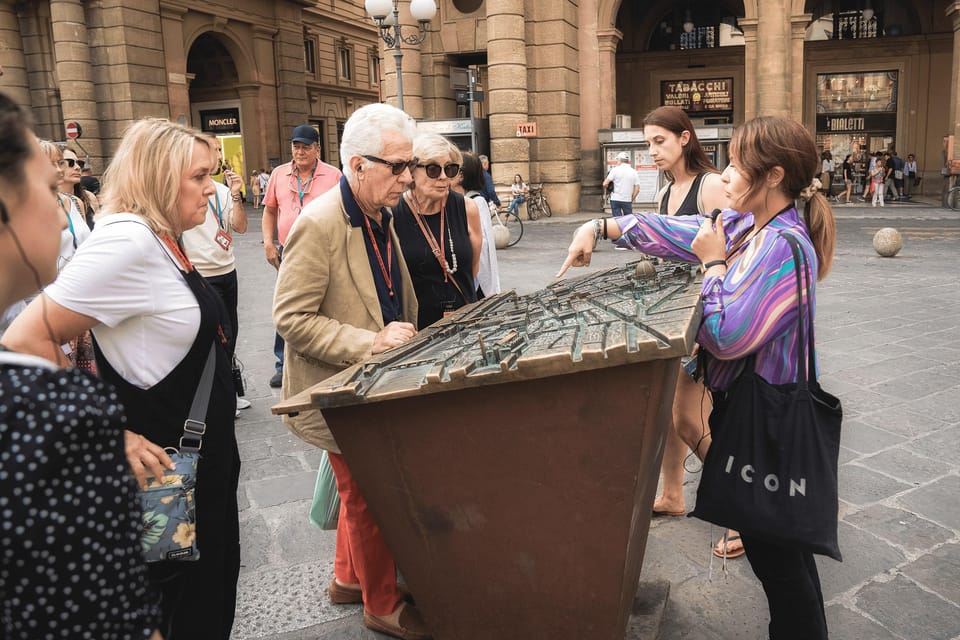
Piazza della Repubblica sits on the site of the forum of Roman Florentia. The granite Column of Abundance marks the old crossing of the main Roman streets. The big arch and grand cafés date from the late 1800s, when the old market and ghetto were demolished.
Detail to findThe long inscription on top of the arch, which proudly announces the “renewal” of the old centre.
06Local ritual
Rub the Porcellino’s nose
Under the 16th-century loggia of the Mercato Nuovo is a bronze wild boar, a copy of Pietro Tacca’s 17th-century fountain. Tradition says rubbing its shiny snout means you will return to Florence. For good luck, let a coin slide from its mouth into the grate below.
NearbyThe loggia also has small stalls selling leather goods and souvenirs.
07Free to see
Read the statues in Piazza della Signoria
This is Florence’s political square. Look for Ammannati’s Neptune Fountain, the copy of Michelangelo’s David at Palazzo Vecchio’s door, and the open-air sculpture gallery of the Loggia dei Lanzi, including Cellini’s Perseus.
Look downA round plaque in the paving near the fountain marks where Savonarola was executed in 1498.
08Shortcut to the river
Walk through the Uffizi courtyard
From the square, the long Uffizi courtyard leads straight to the Arno. Its pillars hold statues of famous Tuscans such as Dante, Leonardo, Galileo and Machiavelli. Street musicians and artists often work here, so it is a lively place to pause.
RememberGoing inside the gallery needs its own timed ticket, so keep that for another part of the day.
09Free to see
Cross the Ponte Vecchio
Florence’s oldest bridge was rebuilt in 1345 after a flood. Butchers once worked here, until Grand Duke Ferdinando I moved them out in 1593 and the goldsmiths moved in. In 1944 it was the only Florentine bridge the retreating German army did not blow up.
Best viewLook at it from the next bridge downstream, the Ponte Santa Trinita, rather than from on it.
10Literary Florence
Explore Dante’s quarter
The tangle of lanes between the Duomo and the Bargello is where Dante grew up. Look for the Casa di Dante museum, the little church of Santa Margherita de’ Cerchi linked with his muse Beatrice, and the bell tower of the Badia Fiorentina.
Look forQuotes from the Divine Comedy on marble plaques around the old city.
11Treasure hunt
Spot the wine windows
Small arched hatches called buchette del vino are set into many palace walls. Noble families once sold wine from their estates through them directly to customers. In 1634 the scholar Francesco Rondinelli described them being used to limit contact during a plague outbreak.
Fun factA few reopened during the Covid pandemic to serve wine, coffee and gelato.
12Food stop
Graze at San Lorenzo and the Mercato Centrale
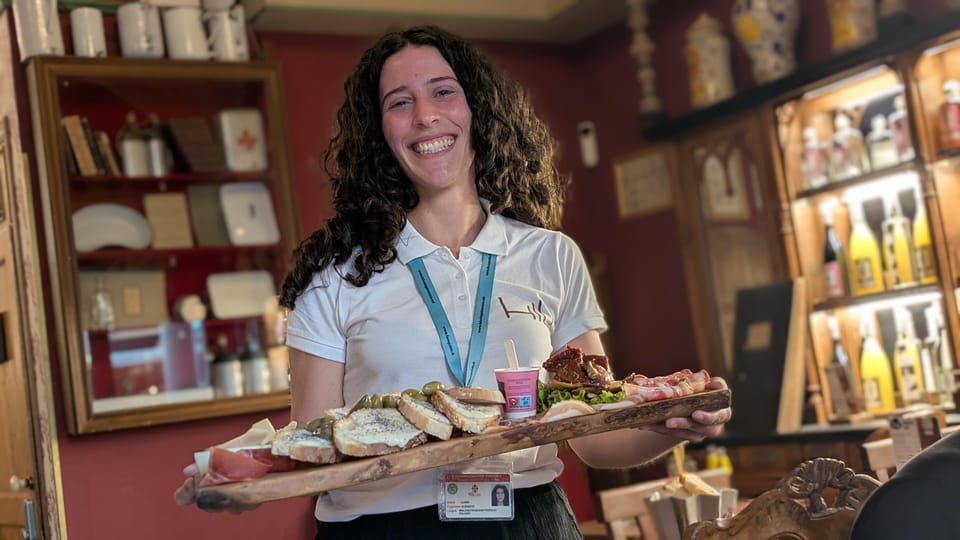
North of the Duomo, outdoor stalls fill the streets around San Lorenzo. The iron-and-glass Mercato Centrale, opened in 1874, has fresh produce downstairs and a food hall upstairs. It is the easiest place on any walk for a proper lunch break.
TryLampredotto, a slow-cooked tripe sandwich, from a market stall or a street kiosk.